itting on the edge of a roundabout in Asmara, the capital city of Eritrea
and the centre of Italy’s former African empire, the Fiat Tagliero
service station is a glorious sight: art deco lettering spells out its
name in both Italian and Amharic in a font worthy of a Fellini film
poster, while two 30-metre concrete wings soar across the former garage
forecourt below, mimicking an aeroplane.
The building’s wings are full of the bold attitude of a bygone era in Eritrean history. Built in 1938 by Italian architect Giuseppe Pettazzi,
it was the year Europe teetered on the brink of world war, and in
Italy, prime minister Benito Mussolini and his Fascist party were no
longer just flirting with their imperial ambitions to conquer as much of
Africa as possible.
Mussolini had inherited the Italian colony of Eritrea from the European “scramble for Africa” that began in the 1890s. In 1936 King Victor Emmanuel III of Italy
crowned himself the Emperor of Ethiopia, a title never recognised by
the international community, and from a settlement on the Eritrean Red
Sea coastline, the Italians spread their colonial campaign across the
Horn of Africa.
For Mussolini, Asmara was the nexus in his new Roman Empire – and the administrative centre of his AfricaOrientale Italiana. He called the city “La Piccola Roma” – Africa’s little Rome. READMORE
Mussolini called the city ‘La Piccola Roma’ – Africa’s little Rome. Photograph: Natasha Stallard/Brownbook
Fascist Italy actively encouraged emigration to Eritrea and by 1939,
according to a census of the same year, over half of Asmara’s population
was Italian. Handed over as a blank canvas for Italy’s most radical
architects, the city found its new role as an unlikely playground for
futurist architecture.
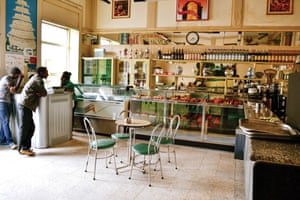
Mussolini encouraged Italianarchitects and engineers to transform Asmara into an urban utopia, full of cinemas, cafés, imported bicycles and sycamore trees.
“[The Fiat] is the reason I became an architect. It’s a very peculiar
building. Structurally it was very bold. Engineers nowadays wouldn’t
dare to build a cantilever half the size of that,” says Mesfi Metuasu, a
local architect and urban planner who has been working with Asmara’s
buildings since 1995.
e
star of the show, and for good reason, is the Fiat Tagliero gas
station, designed in 1938 by Giuseppe Pettazzi to look like an airplane,
a spaceship or possibly a bat. Mr. Pettazzi’s extraordinary flourish
was the concrete wings that jut out a total of more than 90 feet. The
municipal authorities at the time required him to build pillars under
the wings so they wouldn’t collapse, which was an unforgivable insult to
Mr. Pettazzi. According to local legend, Mr. Pettazzi installed
detachable pillars, and at the station’s opening, he pulled out a pistol
and forced the builder to remove the supports. Needless to say, the
wings are still there.
We saw many of these modernist gems as we strolled around Harnet
Avenue. The whole city, with its broad boulevards and wide sidewalks,
was laid out with the passeggiata, or evening stroll, in mind. At
sunset, thousands of people hit the main drag and you can feel the
communal spirit, going back to the days of the struggle. “Do not talk
about self,” read one sign in English. “It will be done when you leave.”
It was in this collective, understated spirit that Eritreans built a
most original war memorial. Eritreans chose not to put up a statue of
Mr. Isaias or some other famous man but of a pair of giant sandals —
yes, sandals. The shida sandal, a $3 black plastic shoe that is actually
quite uncomfortable unless you’re hiding in a bunker and have bigger
worries, is the official symbol of the struggle. In the center of town
is a pair of 20-foot-long sheet metal shidas. In the 1980s, Eritrean
rebels built a mobile shida machine underground that survived countless
bombings. The sandals became legendary.
We found most people here friendly, unless the subject was politics,
which then seemed to bring out a prickly side. Eritreans are fiercely
proud of their independence and reluctant to criticize their government,
which has jailed political opponents. “The problem with Eritrea,”
explained an Eritrean friend who has left the country, “is that half of
my friends are in prison and the other half put them there!”
After a few days in Asmara, we headed to Massawa, Eritrea’s
swelteringly hot and therefore not surprisingly sleepy beach town. We
took the steam train about a quarter of the way and then had a driver
meet us and went by road for the rest. The train was built by the
Italians starting in 1887 and still operates, though mostly for
tourists. Along the way, the train stopped many times to load up on
coal.
“The engine’s good,” the train’s equally ancient engineer, Seyoum Kidane, reassured me. “Just a little leakage.”
Massawa is hot, moist, quiet and battle-scarred. It’s a place where
you can see the cost of the struggle, like the Ottoman-era buildings
with their roofs blown off and sea walls raked by machine-gun fire.
There is a beautifully decrepit old bank building along the water where
we picked our way through the cobwebs and rubble and found an enormous
safe still half open (somebody had already cleaned it out).
Some of the world’s most spectacular diving
is in the Red Sea. There are a few dive shops in Massawa with rentable
gear and boats to take you to the Dahlak Archipelago, which includes
more than 200 islands and dozens of wrecks.
At night, when it cooled down a bit (it was still probably about 90
degrees), we took a stroll. The roads by the port are straight, wide and
empty. The 300-year-old Ottoman quarter, on the other hand, is a maze
of little alleyways and crumbling coral houses. The smell of
frankincense wafted from under the beaded curtains of the bars.
Shirtless old men sat at tables in the open air, draining beer from
unmarked brown bottles and slapping down dominoes.
There is not a lot going on in Massawa but that’s part of the appeal.
We had dinner at an outdoor fish restaurant called Sallam. The fish was
barbecued Yemeni-style by slicing it in half, smacking the whole thing
against the walls of a fire pit and baking it to a black crisp. It
arrived on plastic plates with the meat dropping off the bone by the
handful. It was cheap — $20 for four. And delicious.
In many ways, the story of Eritrea is the story of modern Africa, so
much promise melting into so many problems. In just 15 years, Eritrea
has gone from being the darling of the West, the egalitarian,
crime-free, little-country-that-could, to a struggling, closed-off
society, which, in a way, makes it all the more interesting to peek
into.
Modernity will eventually come, hopefully peacefully, and until then
Eritrea will remain a remarkably authentic, singular place to visit. IF YOU GO GETTING THERE
One of the cheaper ways to get to Eritrea from the United States is to fly on EgyptAir (www.egyptair.com.eg)
from New York to Cairo and then connect in Cairo to Asmara. A
round-trip ticket is around $1,700. Other flight options include
Lufthansa (www.lufthansa.com) from Frankfurt, with a short stop in Jeddah, Saudi Arabia. Or Eritrean Airlines (www.flyeritrea.com) from Frankfurt or Rome. There is also Nasair (www.nasairgroup.com) from Nairobi, Kenya, which we used.
A good travel agent to finesse these details is Travel Inn, in Marbella, Spain (34-952 82-9017; www.arrakis.es/~travel_inn/). WHERE TO STAY Italia Albergo (13 Nakfa Avenue; 291-1-120740; www.albergoitaliaasmara.com)
is a gorgeous old-school hotel right in the center of town. The Albergo
was actually Eritrea’s first hotel, opened in 1899 and refurbished
three years ago. Its lavishly appointed suites include big marble
bathrooms, Corinthian columns and balconies that swing open to the
street. Single rooms are $88 and double rooms are $132. (In Eritrea,
prices are typically quoted in either dollars or nakfa, the local
currency, with a current exchange rate of 15 nakfa to the dollar.) Book
ahead for October and November, the busiest tourist time of year, thanks
to the idyllic weather. The hotel does not accept credit cards.
In Massawa, we stayed at the Red Sea Hotel (291-1-552839),
right on the water. The rooms were clean, simple and, thankfully,
air-conditioned, with a double room costing $32. WHERE TO EAT
Asmara has excellent, inexpensive food. Lunches are usually no more than $10 and dinners $20.
The Albergo serves up tasty Continental cuisine in a dining room that is nothing less than elegant.
We also enjoyed Casa Degli Italiani (Mengesha
Yohannes Street, 291-1-120791), the old Italian club from the Fascist
days, with a huge Italian flag still flapping. The service is slow, but
it lets you admire the pigeons in the courtyard. Most importantly, the
mozzarella is home-made and the spaghetti Bolognese (110 nakfa, or about
$7) is excellent.
There are also some great local finds, like the Blue Bird Restaurant
(291-1-117965). Eritrean food is a lot like Ethiopian food: mashed-up
lentils; beef with peppers; spongy injera bread — all washed down with
tej, a honey wine served in grenade-shaped decanters. Dinner for two
should run about 160 to 200 nakfa.
We found a very helpful travel agent in Asmara — Tedros Kebbede, of Travel House International, (291-7111-487, www.travelhouseeritrea.com). Mr. Kebbede can arrange guided tours, drivers and trips on Eritrea’s steam train. He can also help with hotels in Massawa. readmore